Categories
Blogs

Upcycling Clothing & Furniture

Let’s dive into the world of upcycling – the art of transforming old, worn-out stuff into hip, trendy treasures. If you’ve got a closet full of clothes hanging on for dear life or a piece of furniture that’s seen better days, it’s time to channel your inner DIY maestro. Here are a couple of cool ideas to turn your tired threads and furniture relics into something Instagram-worthy!

Upcycling Clothing Ideas:

1. Denim Revival

Got a pair of jeans that have more holes than fabric? Fear not! Cut them into shorts, add some funky patches, or turn them into a denim tote bag. Denim is like the duct tape of the fashion world – it fixes everything and can be molded into anything. With a bit of creativity and a sewing machine, those old jeans can become your new style statement.

2. T-shirt Transformation

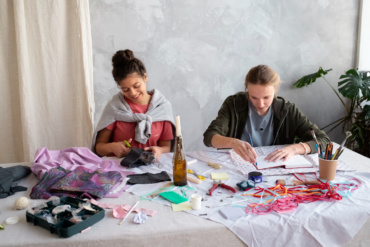
We all have that stack of old t-shirts we can’t bear to part with. Time to break out the tie-dye kit! Whether you go for classic spirals or channel your inner artist with abstract designs, tie-dyeing turns plain tees into vibrant, one-of-a-kind masterpieces. Pro tip: Oversized tie-dye shirts make for perfect loungewear or beach cover-ups.

Upcycling Furniture Ideas:

1. Pallet Power

Pallets are like the Lego bricks of the furniture world. With a bit of sanding and a splash of paint, you can turn these humble shipping platforms into coffee tables, bookshelves, or even outdoor seating. Get creative – stack them, paint them, and voila, you’ve got yourself a custom piece of pallet perfection.

2. Suitcase Shelves

Have an old suitcase gathering dust in the attic? Turn it into a quirky set of shelves! Just attach it to the wall, open it up, and boom – instant storage with a vintage twist. The best part? You don’t need to be a carpenter extraordinaire to pull it off. It’s the kind of DIY project that’s easy, fun, and earns you major style points.

Upcycling is not just about saving money; it’s about giving new life to the things you already own. So, grab those scissors, raid your closet, and get ready to turn the ordinary into the extraordinary. Whether you’re rocking revamped denim or showcasing your DIY furniture finesse, upcycling is all about embracing the beauty of imperfection and making sustainability look seriously cool. Happy crafting!

Categories
Blogs

What Types of Fabrics are Made in America?

When it comes to fashion and textiles, the origin of your clothing can be as important as the style itself. In recent years, there has been a growing interest in supporting local industries and choosing products that are made in the USA, as opposed to items made in bulk in factories abroad. If you’ve ever wondered about the fabrics that make up your favorite American-made garments, you’re in the right place!

One notable trend is the increasing emphasis on sustainability and ethical practices within the industry. This shift has led to a resurgence of interest in domestically produced fabrics, with both consumers and businesses recognizing the benefits. In the quest for sustainable fashion, consumers are increasingly seeking out fabrics with a lower environmental impact. This aligns with a broader movement toward mindful consumerism and a desire to make environmentally conscious choices.

Cotton and denim: Staples in American Textiles

Cotton has long been a staple in the American textile industry, and it continues to play a crucial role today. Companies like Red Land Cotton are leading the charge for American-produced cotton. Their products highlight the importance of supporting local cotton farmers and the communities that depend on this age-old crop.

Denim is another notable textile that is proudly made in America. With a rich history dating back to the 19th century, American denim has become synonymous with quality and craftsmanship, often selling for a high price to consumers. The iconic blue denim jeans, a wardrobe staple for many across the world, often find their roots in the denim mills scattered across the United States.

Technical Textiles and Innovation

Apart from traditional fabrics, the U.S. textile industry has seen a surge in the production of technical textiles. These advanced materials are engineered for specific functionalities, ranging from medical applications to industrial use. This shift towards innovation ensures that the American textile industry remains at the forefront of global competition, staying a step ahead of competition.

By choosing garments made from fabrics produced in the USA, consumers can not only embrace a sense of patriotism but also contribute to the sustainability and resilience of the American textile industry.

Written by Jack Vale in partnership with Arena Prints screen burning services

Categories
Blogs

Frances Harder selected as Top Founder/President of the Year by IAOTP

Decades after stepping onto the proverbial runway of her career calling, Frances J. Harder is still making multiple strides motivated by her personal motto, “Passion for fashion.” Heavily influenced while growing up by her father, a textile engineer, and her mother, a fashion designer for her uncle who owned a factory, Ms. Harder initially planned a career in graphic design, yet her mother implored her that pursing fashion design would ensure that she’d always know how to sew for her children. Heeding the advice while weaving in a solid educational foundation earning a Bachelor of Arts in fashion, with honors, from the University of Salford, in the United Kingdom, today, Ms. Harder is a curriculum advisor of fashion programs and an adjunct professor at California Polytechnic State University as well as the founder, president, and owner of Fa$hion for Profit Consulting in California.

Ms. Harder thrives in the fashion and education arenas, bolstered by her professional mission to make a difference by educating people and consulting with others working in fashion to make running their businesses less stressful. She has advised numerous colleges, which has included sitting on the dean’s advisory board for the merchandising department at California Polytechnic State University. With an expert’s eye, she provides clients and students with wise, helpful overviews and insights into the latest happenings in the fashion industry as it relates to design, product development, marketing, manufacturing, and most everything that goes into producing garments. Ms. Harder’s prowess has garnered widespread respect, including the distinction of being consistently named to the Los Angeles’ Most Influential People list in California Apparel News, TLM Publishing Corp., between 2000 and 2018.

Having established deep and longstanding relationships at all levels in the industry, she is a consultant with the International Trade Centre, the World Trade Organization, the United Nations, and an apparel business and design consultant with various companies in England. Ms. Harder also serves as an expert witness regarding industry-related issues such as chargebacks, trademarks, copyrights, trade dress, trade secrets, patent infringement issues, and research and development. As a designer, she was tapped to produce two fashion lines for Priscilla Presley working with the Home Shopping Network.

During the past 20-plus years, Ms. Harder has shared her knowledge through creative works in the United States, England, Canada, Nepal, Peru, Egypt and other worldwide locations and as either a presenter, organizer, or moderator at various national and international trade shows. They include, yet not limited to, MAGIC International, the Apparel Textile Sourcing Show, Hong Kong World Boutique, the LA Textile Show, Phoenix Fashion Week, Emerald Exposition, ASD Market Week, and others. Furthermore, as an authority, Ms. Harder educates the public through her own Harder Publications company, which has published titles that she has authored such as “Costing for Profit,” “Fashion for Profit: From Design Concept to Apparel Manufacturing and Retailing – A Professional’s Complete Guide, 10th Edition,” “Brand Building for Profit,” and the “Forms for Profit,” CD-ROM.

Ms. Harder’s extensive experience spanning four decades prepared her well for her current roles. A mere sampling of her previous positions has been as an adjunct Professor at Woodbury University, a consultant with the training center at Microsoft, associate professor at the Otis College of Arts and Design, a freelance technical designer and fashion designer for various entities, designer of her own junior contemporary fashion line, department chair for the fashion program at The Art Institute of California, a faculty member at the Fashion Institute of Design & Merchandising, and many other key positions in the U.S. and abroad. Merging her profession with civic responsibility, Ms. Harder was the founder and president of Fashion Business Incorporated for 18 years and a member of the District Export Council of the Federal Trade Commission for six years. She also often donates to charities.

Ms. Harder believes her success is the result of enjoying her work, being open to networking, her willingness to change especially when opportunities arise, recognizing opportunities and striving to do her best to make them work for her and others. Peering forward, she expects to continue consulting with new companies to help them flourish, conducting seminars, and serving as an expert witness for industry-related legal issues.

While proud of her accomplishments, most important to Ms. Harder is her family. She is married with two grown, professionally successful children and has two grandchildren. In her personal time, she paints, presents art exhibitions, and exercises.

www.iaotp.com/award-gala

Categories
Blogs

Things You Need to Know Before Having Samples Produced

A question I have been asked repeatedly over the years is about working with patternmakers.

By Frances Harder

Fashion for Profit Consulting

When interviewing a potential patternmaker, it is a good idea to ask for references and to see examples of finished samples they have produced. To be able to translate a two-dimensional sketch into a three-dimensional garment, a patternmaker needs to have developed an eye for design. Their finished work will speak for itself, giving you an idea as to their standard of work and their interpretive skills. Don’t try and cut costs with this critical part of producing your line. Like all professions, there are good patternmakers, and then there are … others.

Professional patternmaking services usually have a pay scale as to how long it will take to make a particular pattern. For example, jackets would cost more than blouses, and a skirt would be priced less than a pair of pants. The price is usually set for certain types of garments. A simple skirt could cost around $125, but a fully lined jacket could be as much as $700. Denim jeans may cost the most as they need two sets of specifications made for the pre-washing measure and the post-washing measurements.

When negotiating with the patternmaker for their rate of pay, you need to find out if they will make adjustments to the pattern, should you find it to be unsatisfactory. One or two (at the most) pattern adjustments are normal and should be included in the cost of making the pattern. If, however, it’s your mistake because you changed your mind about any details, then you will be responsible for having the pattern remade at your expense. Therefore, it’s essential that you know exactly how you wish the finished garment to look. This should include all the stitching details, down to the number of buttons, the size and placement. Patternmakers should not be put into a position where they have to guess what the designer/manufacturer ultimately wants. They must be able to fully understand your design to translate the flat sketch into an actual garment. A flat (technical drawing) of the clothing is sketched with finished dimensions and sewing details, such as topstitching and zipper length.

If you’re trained in draping and patternmaking, then making your own first patterns will, obviously, save you a great deal of money. It is also more likely that you’ll achieve your vision of how you would like your finished garments to look and be produced. Having to have your samples remade several times before it’s to your satisfaction can be costly.

The contractor that you plan to use for your production can often also make your first samples. This has the added advantage of the contractor being able to cost the garment for production. Contractors usually like to sew the first sample, as they hope that they will then be ready to sew your production orders. Using this method allows the contractors to become aware of any problems involved with sewing a particular style, and it enables them to give a fair estimate of the costing. As a rule of thumb, sewing the first sample is usually two to three times the price of sewing a garment in production. Frequently, good patternmakers are working with different types of sewing contractors for your production needs.

Word of caution: Once you have paid for the work, then you own the patterns. If the patternmaker keeps the patterns, you need to ask for a printout of the patterns for your own records. You should have a “Work for Hire” contract with your patternmaker.

In the copyright law of the United States, a work made for hire (WFH) is a work subject to copyright that is created by an employee as part of his or her job, or some limited types of works for which all parties agree in writing to the WFH designation. Generally, the person who creates a work is considered its “author” and the automatic owner of the copyright in that work. However, under the work made for hire doctrine, your employer or the company that has commissioned your work, not you, are considered the author and automatic copyright owner of your work.

Lastly, I would like to recommend that you checkout Icrest as a marketplace is proving to be a boon in today’s scenario of business situations, helping consultants to sell their business tools and earn passive income. At the same time helping users to get available industry driven business tools at a affordable rates

For more industry focused advice on our rapidly changing industry with any aspect of your apparel or textile business please check out our new platform: www.fashionforprofit.com. We have our professional finger on the pulse of the many changes that are affecting both manufacturing and retailing platforms. If you are an industry consultant, or offer resources, we invite you to list your qualifications and your industry specialty under Consultants on our website. There is a nominal annual fee of $200 but if you sign up through this article, we will give you a $50.00 discount if you use the code: FFPSamples . We have a new updated data base of approx. 15,000 that is industry focused. We also invite any experts to pitch a topic to be a presenter of our new proposed podcasts, or to present a topic at the many industry trade shows we are invited to present.

Fashion For Profit Consulting will be back once again presenting a variety of relevant topics for MAGIC Sourcing online in September through November, to present daily seminars that are industry focused seminars. So, please do check out our new platform and connect with our team!  

Please do not hesitate to contact us if you have any questions, comments, or concerns!

Sincerely,

Frances Harder

President/Founder

Fashion For Profit Consulting

frances@fashionforprofit.com

www.fashionforprofit.com

Categories
Blogs

CUSTOMIZATION & 3D PRINTING IS THE FUTURE – Could it be the solution for the apparel industry?

By Frances Harder

The apparel industry is at a very crucial cross road. The massive amounts of unsold new clothing end up as waste, and old discarded clothing also end up in a landfill or burned is staggering. Approximately, only twenty five percent of all clothing in stores are sold at full retail price and the rest are either discounted or destroyed. Of course, what we wear is important for us all but most of us in the western world have more than enough clothing in our wardrobes. Women are the biggest consumers of fashion purchasing and often buy more for a reward than a real need for a new sweater. 

Globally the fashion industry employs 60 million people and generates trillions in revenue, but all are at risk. Production issues and land to grow cotton or farm is under dire stress due to the limit of planetary resources like water. Additionally, consumers are asking for more sustainable methods of production, however for the most part consumers don’t seem to be willing to pay more for garments made in any sustainable practice. Additionally, globally apparel workers are demanding safer conditions and higher wages, which of course they have every right to demand. But obviously higher wages equal higher costs for goods to the consumer.  All of the above issues mixed with the weakening of any dictated fashion trends are also a perplexing issue for apparel manufactures. So, what is the solution?   

In my mind I see that the future of fashion will be the evolution of the new world of the technical advancements in 3D printing.  To explain 3D printing simply, because it is a complex process that transforms digital information into an electronic design file. Guided by a design file, a 3D printer lays down layer after layer of raw material to “print” out an object. It could be a shoe, or a handbag, or as this technology progresses and evolves clothing of all types. I am convinced that 3D printed garments will be the next evolution that will be widely available to all and change the world of fashion and bricks and mortar. Retailers are closing as more purchases go online but maybe this new process will open up more doors. A customer can go to a store and choose a design from files or samples. Then have your body scanned to achieve the perfect fit and you can also even see a 3D image of yourself wearing your new outfit. Then the next day your dress will be shipped. Once you have finished with your old 3D printed garments then you can return them to the store to be melted down and reuse! NO WASTE!! ?  

Stella McCartney, the clothing designer and daughter of Paul is a leader and groundbreaker in the use of 3D printing in the world of fashion. She has showcased her 3D designs on the runway and you can find her clothes and shoes to purchase from her website, or another good place is “Farfetch”. You can even print your very own Paul McCartney. I look forward to seeing more innovation in fashions from Stella!  Big shoe brands are also 3D printing their new footwear models.

3D is also being used in many other industries including the medical field & the building trade. 3D is also breaking new ground and is being used to print bones, organs and other body parts. The building trade is 3D printing walls and other construction parts! Just amazing!! Very exciting! Watch this space.

Categories
Blogs

Unlocking the Secrets of a Fashion Cost Sheet: Everything You Need to Know for Successful Product Pricing

‘Look after the cents and the dollars will take care of themselves’

Why does a dress cost $300? Is a cotton shirt worth $75? The sticker price of that dress you’re considering or the shirt you are saving for can depend on the complexity of the design, the status of the label and whether the clothing is made overseas or domestically. What goes into the clothes you buy can sometimes make the sticker price as high as a luxury vacation or as low as a pizza and a movie. The answer is layered in the long, complex journey a garment makes in the process of creation, production, testing and shipping that brings it, finally, to the retail store. It also reflects the retailer’s overhead costs, for security, real estate, technology, etc.

Understanding how to correctly cost a garment will be the key to your company’s success. One small miscalculation can be devastating to your profit margins and could undermine the survival of your start- up business. Once you have determined the market and price bracket that your company will be in, you will have to strive to maintain the quality of styling and construction within the set price structure. For a small start- up company it is very difficult to be competitive with bigger manufacturers in moderately priced and budget clothing. Unless you are investing a few hundred thousand to start your company, the higher price category is usually the best place to start. There is a higher profit margin to the manufacturer and to the retailer in ‘betterwear’. Granted the orders will be smaller, but it is hard to find financing for large orders when you are a start-up company. Most start-ups will not be able to afford to produce large quantities at first, without borrowing money. Start with small orders. When mistakes are made it will not be too devastating to the company both financially and emotionally. You will be able to learn by your mistakes.

Major Costs

The major costs involved in manufacturing any garment are fabric, trims, labor, and operational costs. Becoming familiar with labor costs takes experience in understanding the over-all work involved in the completion of the garment. Direct labor for sewing will be negotiated with the contractor. Marking and grading may be done by one company, cutting done by another, (or in some cases) your contractor may be able to take care of all these steps in producing your product. All these costs must be calculated by the number of garments made. For smaller orders there will be a higher price to pay. The more garments sold or the bigger the order, then the labor price decreases. Other labor costs to be considered are design development, first patterns, production patterns, quality control, bookkeeping and shipping. Overhead costs or fixed costs should not be forgotten including rent, electricity, etc.

Chargebacks & Markdown Refunds One of the more controversial factors in apparel prices  is  retailers’  request  for  ‘chargebacks’ or  ‘markdown’  money.  Chargebacks  can  be demanded by a store for late deliveries or for a variety of other reasons. If too few garments sell at full price, sometimes department stores go back to the manufacturer to ask that they share in the losses from discount sales. Ironically, markdown money, or credit demanded by a retailer adds to the manufacturer’s overhead costs and may boost the original retail price of the garment. Another cost that retailers expect the manufacturer to share is the cost of advertising, promoting the product in store flyers and newspaper advertisements.

Smaller specialty stores  are  less  likely  to make such requests, but they have less buying power with the manufacturer. Markdown and chargebacks have become a very sensitive issue

and many manufacturers are refusing to do business with larger department stores because of this problem. The wise manufacturer calculates both of these into the costing of the garments

Importance of Correct Costing Incorrect costing can result in losses that will eventually bankrupt the company. If the costing for cutting, sewing, or trims is incorrect, or if the yardage has been under-calculated, then the costing for that garment will result in major losses. Costing is done before the orders are written so it can be difficult to calculate how big the order will be. Therefore, it is important that start-up companies project the size of production and the money available to produce the orders. You could be out of business in a very short time without an experienced costing person filling in the cost sheets. It is also crucial to have an accurate fabric yield and a precise production cost. Never guess your costs!

Market Research

When starting a new company, it is important to assess the market, shop your  competition and find out the critical price points of similar products in the market place. To cost products too high could mean no orders and to charge too little could result in no profits. Know the three stages of costing:

  • ‘Actual cost’ of production: This is more or less a fixed price and can only be reduced by modifying or changing the garment.
    • Cost plus your markup percentage: Deciding on the mark-up will be determined by a couple of factors: How much do you need to make in order to make a profit? What will the market price will bear?
    • Retail-selling price: Having a realistic understanding of the price structure of the market place will help when costing.

Costing for the Start-Up

A simple method of costing for start-up manufacturers is to make the price you sell to the retailer at least twice your cost. This should give you a 100% mark-up, which is a necessary profit

margin when you first begin to manufacture and have small orders. The term used for this is ‘keystoning’. However, be careful for any hidden costs. This method is not the most reliable or accurate.

Example If your basic cost is $20, you will sell your garment for $40. This is ‘keystoning’ which equals a 100% mark-up. If you go back from the

$40 to the cost price of $20, that will equal a 50% gross profit margin. Understanding these basic terms will help you understand how they should be used.

Never go below 35% gross profit margin, or you will be giving the garments away! Subjective thinking will come into play sometimes when you have to take a smaller mark-up on the pricing of certain styles in order to keep a group together. Hopefully, this will make the group more saleable. Conversely, there will be times when you will mark-up a garment more than 100% to keep the garment in the correct price category. If you do reduce the profit by lowering the wholesale price of a garment, make sure that if the garment sells well and the store wants to reorder, you then adjust the price higher. If not, you may find that this garment will end up losing money for you season after season. Only compromise the cost of a garment if it is to keep a group together and you feel that removing it would harm the overall sales of the group. Your goal is to try and keep the garment at the right price point for maximum sales and profit. To do this you may have to rework the particular garment with the production pattern maker to make it fall in the right price range.

Mass Production

For manufacturers producing mass production on a large scale, the mark-up percentage is usually smaller and pricing more competitive, due to the large quantities produced. They can safely work with a 30% profit margin – you cannot! Retailers such as Forever 21, The Gap, Old Navy, Banana Republic, Limited and Ann Taylor have a price edge because they can deliver their goods directly from the factory to the public without the independent middleman. This is known as

vertical production or manufacturing.

(Discount chains such as T.J.Max, Ross or Marshall’s usually take lower profits in place of such perks as sales help, personal shoppers, carpets and fancy dressing rooms. Manufacturers often have discounted goods left in stock after the season is finished that needs to be moved rather than added to their inventory Discount chains can buy this merchandise at a low cost for sale in their stores ).

Custom Made Clothing

When costing a ‘one-off’ garment it is important to establish an hourly worth of the designer/ producer. Only when you know this can you begin to estimate the costs involved of producing a unique, one-of-a-kind, wearable piece of art.

Once you have established your hourly worth, double it and add it to all other expenses. This will give an approximate cost of the wearable art piece. If the custom- made piece has been commissioned, it is a general rule to ask for fifty percent up-front, since it is often impossible to sell to anyone but the original buyer. If you know the buyer, it may not be necessary to ask for fifty percent up front, but otherwise protect yourself from being left holding an unclaimed garment. To guarantee payment upon completion, finished pieces may be shipped either COD or Pro forma. It is a good idea to take a credit card payment before you ship. Then make sure that the payment goes through before shipping.

Computer Programs

With all the new computer programs available for managing your business, it is advisable to get a program customized to your own specifications to cover all the fixed costs of your garments. Then, the yardage, labor costs and fixed costs can be calculated, fed into the program and a correct costing made of each style. Once programmed to your specifications, these programs will calculate the gross profit margin and the net profit margins of each garment. Remember, the computer is only as good as the user, so be sure that the information programmed into the computer is correct.
Categories
Blogs

Sustainability and Materials

By Jill Mazur – Independent Technology Consultant

We’ve just entered a new decade and with it comes the awareness that we need to make a greater commitment to preserving and protecting our resources, environmental and otherwise.  Consumers and retailers are starting to get on board with the concept of sustainability, which has become a necessity, not a luxury.  Recyclable, recycled, renewable and regenerated materials are entering the mainstream and helping make products more environmentally friendly and safer for future generations. 

Having just read that paragraph might make you ask “what’s the difference between ‘recyclable,’ ‘recycled,’ ‘renewable,’ and ‘regenerated’ materials?”  You wouldn’t be the first person to ask for clarification.  Each of these types of materials has a distinct classification and suitability for different purposes.  Footwear company Rothy’s produces shoes which contain recycled, recyclable and renewable materials – using recycled plastic bottles or renewable merino wool to create threads to knit their uppers and recycled materials to create their foam insoles.

Recyclable materials are resources that have the ability to be naturally and organically reused in one capacity or another.  Post-consumer plastic bottles, worn-out fishing nets, discarded rubber tires and even coffee grinds are used to make clothing, sneakers and accessories.  Industrial materials such as airbags, seat covers, carpets and linings are used to make outerwear, luggage, accessories and handbags. 

Recycled materials are the process by which old fibers, textiles or clothing are recovered for reuse.  Companies such as Patagonia are using recycled wool and cashmere fibers to create new sweaters.  Mud Jeans has created a circular business model based on selling jeans, taking the used jeans back, when returned by the consumer at the end of their wearing, then recycling the used jeans into new ones. One of the challenges presented with using recycled fibers such as cotton, wool or cashmere is that the fibers will degrade over time.  Many steps in the recycling process of fibers can weaken or shorten the fibers.  In order to process these virgin fibers into recycled materials additional fibers or substances have to be added to boost the integrity of the materials.  Some companies may add in new, virgin wools, cottons or recycled polyester or rayon fibers to create the new fabric or material.  Some companies take existing garments and scraps to repurpose, reuse or upcycle one garment into another, thereby diminishing the need for new fabric altogether. 

Regenerated materials are created by dissolving the existing material and extracting either the fibers (such as cellulose) or restoring and purifying the material to create yarn (such as Econyl© nylon).  Viscose, rayon, acetate, triacetate, modal, Tencel©, and Lyocell© can all be regenerated cellulose fibers which are generally blended with other fibers to add strength, whereas the Econyl© nylon actually is regenerated into the exact same compound with no degradation, but can be spun into carpets, swimwear, accessories, etc.

Renewable materials are materials that have the capability to be naturally and organically replaced in a set period of time.  Arguments can be made for and against considering some of these to be renewable materials, but one thing is for sure, they’re all derived from natural sources and those sources can be renewed. 

  • Organic cotton – Cotton itself is a very thirsty crop and the pesticides used to maintain those crops are incredibly polluting.  Many companies are moving toward using organic cotton instead, eliminating the use of pesticides and toxic chemicals.  Using natural dyes, or colored strains of cotton further reduces the amount of chemicals dumped into the environment. 
  • Bamboo – Bamboo is a fast-growing, resilient grass and can generally be grown without pesticides.  It’s also breathable, biodegradable and, some say, antibacterial.  However, most of the world’s harvestable bamboo is grown in China, without much oversight to confirm it’s being grown organically or what type of land is being cleared for farming.  Currently the FTC requires companies to label bamboo fibers in apparel products as “bamboo-based rayon.”
  • Hemp – Hemp is another fast growing, rapidly renewable fiber that can be grown without pesticides, fertilizers or other chemicals.  With restrictions regarding the growth of cannabis plants, from which hemp is harvested, being lifted, more hemp based fabrics are bound to become available and will be a much more affordable option for many companies. 
  • Organic Wool – Wool is the ultimate renewable fiber.  Look for wool from humanely treated animals and fibers that are chlorine-free.  Organic wool has become more available to consumers and is produced without treating the animals with toxic chemicals.  

Sustainability isn’t just a buzz word these days, it’s a necessity.  Our resources are finite and deserve to be treated with respect for the planet.  By incorporating recycled, recyclable, renewable and/or regenerated materials into our supply chain and figuring out ways to reduce or eliminate toxic, polluting and non-degradable materials from our products we can help preserve our planet and resources for generations to come. 

Jill Mazur is an independent Business Process and Technology consultant based in Los Angeles, CA. 

jillmazur@yahoo.com

Categories
Blogs

Buzzwords that Redefine the Modern Apparel Industry

Frances Harder

With the Millennials and Gen Z consumers’ ever-increasing awareness and sensitivity to address sustainability, social injustices, wearable technology and recycling to name a few affecting their buying power that is demanding change from traditional manufacturers and retailers. The new buzz words are a new recipe to consider when starting your own brand. It will be important to analyze how in particularly can these new descriptive words be incorporated to improve the chances to be successful as a brand in this rapidly changing retail environment.   

  • Athleisure – Athletic clothing to wear all day! From Gym to lunch or keep the leggings and a nice blouse and a jacket, or long top over the leggings, and your good to go from gym to lunch and to dinner.
  • New Technology for Textiles – Fabrics made from sea weed, fermented wine and recycled plastic to name a few revolutionary textiles.
  • 3D Printing – From shoes, bags, jewelry and soon to be available in clothing. Choose your style and print it. Then when you have enough of that style you can recycle it.  Go to a store have your body scanned and choose a style and see that style virtually on yourself. If you like it they would 3D print it and then ship it to you.
  • Sustainability – Recycling, upcycling from old to new and bio degradable fibers to name a few. So much is happening due to the demand to address the landfills full of used clothing.
  • Smart Clothing – By combining fiber with electronics, to develop smart performance clothing, like temperature control, medical measurements, fall down detection and positioning. All of these innovative textile’s modules can all be controllable with apps.
  • Online Sales – Amazon – Prime! The Elephant in the Room!  Direct online sales to the customer is now here to stay and growing. Bricks and mortar are forced to change their business model, or face closures.
  • Immediates- Speed to market – With direct sales this means a need to get the goods to the customer as fast as possible. Manufacturers are producing goods ready to ship.
  • Popup Stores – The new way to market and sell direct to customers through a one- or two-day popup store that could be inside other stores or a standalone location.
  • Mass Customization – Made to Measure – Go to your favorite stores and choose a new style. After having your body scanned you will be able to see any styles as they would look and fit on your avatar.  Then the pattern is computerized and changed to fit your own specifications. The garment will then be sewn to your own measurements and shipped directly to you, or you can pick up from the store in case there are any fit issues.
  • Robot Production – Factories are moving over to producing clothing with a factory line of robots.  Big brands such as Nike are investing in building new high-tech factories in states like Arizona and Nevada.
  • Made in the USA – With speed to market in demand there is more investment in creating new more efficient factories and infrastructure domestically.
  • Millennials – Like the Baby Boomers from the 60’s, Millennials are new thinkers and are changing buying habits, which is making retailers rethink their own business models. Sustainable, plastic free, avocado sandwiches to name but a few. They prefer to spend on life experiences than new clothing.
  • Baby Boomers – They are the largest group of aging people and as such have their own demands for their life needs. They want to stay relevant and also look young. As they grow older and hopefully live longer than their parents they will have a market that needs to be catered for.  
  • Eco-Friendly – e.g. Laborites grown leather from mushroom roots, this will help prevent the methane gas that cows create that is contributing to global warming.
  • Social Media – Finding positive “Influencers” to provide marketing and outreach is a crucial part of building a brand in 2019.
  • Recycle – Taking plastic bottles and melting down to then mix with organic cotton to create an Eco-friendly t-shirt is one of the new examples of both sustainable and recycling and even upcycling.
  • Upcycling – Many upscale stores are now asking customers to return garments to resale and for that they get a $100.00 coupon for their next sale. Or, buying from second hand stores and Goodwill stores a t-shirt then wash and print your logo and resale on line or at events is another example of this new term that is becoming big with Millennials.
  • Tech Sauvé – As opposed to technically challenged!  Every aspect of business today demands the use of technology. So, in order to succeed in a new business the owner will need to have a clear understanding of all the technical demands or have someone who understands the technological demands. And there are many technical uses that and now integrated into any new business.   
  • Website – From domain name choice to planning a website and brand identification. Before choosing a name for your new business it is important to make sure that any name for the new brand is available and there is no confusion in the market place. Not a good idea to choose a name like Adias as there will be a “cease and desist” letter from the lawyers for Adidas. It would all have added up to a big waste of time and money.
  • Social Injustices – Sweat shop conditions and fare wages are a very important aspect to anyone considering on manufacturing either domestically or off-shore. Please check licenses to ensure your contractors have all their legal permits and documents.  Or, to anyone considering a purchase from a junior labeled store, or a cheap discount store please think if you are purchasing clothing made by sweatshop in some part of the world!
  • Artificial Intelligence – Alexa’s Amazon voice – Is being used in stores to help people navigate stores and work with virtual stylists.
  • Virtual Reality – The beauty departments at Macy’s offer customers the ability to virtually try on eye shadow and lipstick with an augmented-reality mirror. Then other stores scan your body to virtually try outfits and see if you like them before going into a changing room.
  • Mobile Phone Apps – Use of phone apps for check-out – Scan your phone to pay and checkout.
  • Vintage and Resale Stores – With so many clothes hanging in closets and most of which are hardly worn there is a real market for these vintage or slightly used clothing.

All the above points are some important and relatively new developments that are impacting the textile and apparel industry. For brands to flourish and remain in business it will be crucial for them and for retailers to evaluate where they can incorporate these new demands for change. Because, if they choose not to adapt, they may find they will suffer business losses.  

Categories
Blogs

What Your Clothing Colors Say About You

Though it may not come to mind, the colors of clothing that you wear can say a lot about who you are to the outside world.

In order to portray yourself in the most accurate light, you’ll need to know what these color associations are so you can nail them for yourself. So, let’s go through the rainbow as we cover some of the ideas around what we consider clothing colors to say about a person’s energy and personality.

Red

Red is a bold color associated with strong emotions, both positive and negative. On the positive side, it displays passion, love, energy, confidence, and strength. On the negative side, though, it can also signify danger, aggression, and risk.

When people wear red, they come off as energetic and confident, though wearing too much of it can make you seem flashy or conceited.

Yellow

Yellow has positive connotations like happiness, sunshine, creativity, and excitement, though it can also signify immaturity and addiction.

Overall, wearing yellow will make you come off as fun, happy, and positive given the ‘mood-lifting’ properties of the color. However, yellow can also appear quite casual, so limit its use if you’re going for a more formal look.

Green

We associate green with nature, comfort, relaxation, refreshing, money, and balance on the positive side, and envy and mystery on the negative side.

It’s a color that’s very easy on the eyes, so we generally see people who wear green often as well-liked. Overall, green is largely associated with nature, which has a very calming effect that bodes well for wearers.

Blue

Many associate blue with loyalty, calm, honesty, peace, independence, and wisdom, among other meanings. This is one of the colors with very few negative associations, like being shy and cold.

For these reasons, blue is commonly used in business formal attire, given that it generally shows the wearer is in control and has calming effects on those around you.

Violet

Violet, or purple, has positive associations with things like leadership, luxury, wealth, charm, and spirituality. On the other end of things, it can also symbolize unpredictability, shyness, and sensitivity.

There’s a reason so many royals throughout history have worn purple robes and other dressings, as it’s generally seen as a sign of strength and regalness.

Pink

Pink is a color with a more feminine connotation, whose positive associations also include love, romance, comfort, and optimism. However, the color can also be seen as a sign of weakness or vulnerability.

Pink has been shown to decrease aggression in onlookers, so it’s generally a pleasing color to look at when people wear it.

So, next time you’re picking out an outfit for an important event, keep these ideas about color in mind so you portray the right idea about yourself to onlookers.